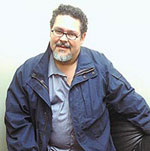
Former Caracas Mayor, Juan Barreto

FRONT PAGE
Site Search
About us | Quiénes somos |
A propos de nous | Über uns |
Mayor Monitor
Directories
Events
Debate

World Mayor
World index of mayors
Mayors from The Americas
Mayors of the Month

City Mayors reports news from towns and cities around the world. Worldwide | Elections | North America | Latin America | Europe | Asia | Africa |

City Mayors ranks the world’s largest, best as well as richest cities and urban areas. It also ranks the cities in individual countries, and provides a list of the capital cities of some 200 sovereign countries. More

City Mayors profiles city leaders from around the world. More

City Mayors describes the history, architecture and politics of the greatest city halls in the world. More

Mayors from The Americas, Europe. Asia, Australia and Africa compete for the World Mayor Award. More

Use Mayor Monitor to rate the performance of mayors from across the world More

In your opinion: Praise Criticise. Write

City Mayors reports political events, analyses the issues and depicts the main players. More

City Mayors describes and explains the structures and workings of local government in Europe, The Americas, Asia, Australia and Africa. More

City Mayors deals with economic and investment issues affecting towns and cities. More

City Mayors describes and explains financial issues affecting local government. More

City Mayors reports urban environmental developments and examines the challenges faced by cities worldwide. More

City Mayors reports on and discusses urban development issues in developed and developing countries. More

City Mayors reports on developments in urban society and behaviour and reviews relevant research. More

City Mayors invites readers to write about the people in their cities. More

City Mayors examines city brands and marketing. More

City Mayors lists and features urban events, conferences and conventions aimed at urban decision makers and those with an interst in cities worldwide. More

City Mayors deals with urban transport issues in developed and developing countries and features the world’s greatest metro systems. More

City Mayors examines education issues and policies affecting children and adults in urban areas. More

City Mayors investigates health issues affecting urban areas with an emphasis on health in cities in developing countries. More

City Mayors reports on how business developments impact on cities and examines cooperation between cities and the private sector. More

City Mayors examines the contributions history and culture make to urban society and environment. More

City Mayors examines the importance of urban tourism to city economies. More

City Mayors questions those who govern the world’s cities and talks to men and women who contribute to urban society and environment. More

City Mayors profiles national and international organisations representing cities as well as those dealing with urban issues. More

City Mayors reports on major national and international sporting events and their impact on cities. More

City Mayors lists cities and city organisations, profiles individual mayors and provides information on hundreds of urban events. More
Juan Barreto, former Mayor of Caracas,
and ally of Venezuelan president Chavez
By Andrew Stevens, Deputy Editor
28 April 2007: Elected as alcadia mayor of the Venezuelan capital in 2004, Juan Barreto had a ringside seat in the ascendancy of Hugo Chavez as a former legislator in his Fifth Republic Movement. Remaining a trusted lieutenant of Chavez and the Bolivarian figurehead for the capital city of Caracas, Barreto’s radical views have brought him into conflict with other mayors in the metropolis and even central government. Juan Barreto was long-listed for the 2008 World Mayor Award.
UPDATE 24 NOVEMBER 2008: Antonio Ledezma elected new mayor of Caracas
Born in 1959, Barreto was educated at the Central University of Venezuela in Caracas, where he became a student leader and graduated with degrees in journalism and social sciences. After a period with the Ministry of Communication, he taught journalism at his former place of study, continuing to do so after his election as a deputy to the national assembly in 1998, representing the Venezuelan Capital District. As legislator, Barreto served in the assembly during the redrafting of the Venezuelan constitution, as stipulated in the Fifth Republic Movement manifesto of Hugo Chavez, which produced the Bolivarian constitution of 1999. Under the new constitution, the Venezuelan Capital District was abolished and replaced with the Metropolitan District of Caracas, which saw the city and four adjacent municipalities (Baruto, Chacao, el Hatillo and Sucre) placed under it as a territorial entity within the federation and with the city-wide Alcadia Mayor being delegated some of the functions executed by these municipalities. Barreto resigned from the assembly when elected as alcaldia mayor in 2004, beating former Chavez ally Alfredo Pena, who later fled the country facing embezzlement charges.
The Venezuelan capital covers a population of around 4.7m across the wider metropolitan area. Caracas featured prominently in the partnership agreement signed between London Mayor Ken Livingstone and President Hugo Chavez in 2006, with city officials visiting London on a range of collaborative projects and most infamously Mayor Livingstone’s abandoned trip to Caracas that year, cancelled while en route owing to the presidential poll taking place. Livingstone also berated the US for what he considered its interference in the country’s sovereign affairs. However, some critics have wondered if Mayor Barreto has decided to copy the London Mayor’s knack for gesture politics and civic insensivity following this forging of links, not least as his tenure as mayor so far has been notable only for hostile coverage.
In August 2006, Mayor Barreto denounced Baruta and Chacao city mayors Leopoldo Lopez and Capriles Radonski, both of the Justice First party and notable for their judicial activism, as “fascists” during an official function. In the face of Barreto’s insults and threats to abolish their municipalities, both mayors have held out for an apology not yet forthcoming from the combative Chavista mayor. Baruta’s mayor Radonski was imprisoned in 2004 for his alleged role in anti-Chavez protests outside of the Cuban embassy in his municipality during the 2002 coup attempt and the legal outcome of the case remains uncertain, with claims that his opposition to the Chavez regime is likely to cost him his liberty, though in a divisive political climate there are no shortage of counter-accusations that he was implicated in the coup attempt. The mayor of the remaining Caracas municipality, Sucre, is José Vicente Rangel Ávalos, son of recent vice president José Vicente Rangel and a key ideological peer of Chavez during their time at military school together.
Two Barreto initiatives have also placed the Caracas mayor in the spotlight. While the plan to expropriate Caracas’ most exclusive golf courses and turn the land over to slum dwellers for redevelopment might sound Chavista in tooth and claw and in keeping with previous social justice policies such as the redistribution of farm land, the off the cuff announcement met with disdain from the government itself. Barreto’s logic, that the land on each course could house 5,000 people, sounds consistent with the aims of the Bolivarian programme but could be viewed as sectarian for the fact that the country clubs concerned are both located in Baruta and Chacao. Barreto’s declaration in 2006 that Caracas was a “homophobia-free zone” might also share a GLC-era Livingstonian bent were it not for the ironic fact that Chavez and his allies remain in thrall to Castro’s Cuba, the object of much international derision over the regime’s hostile approach to its lesbian and gay community.