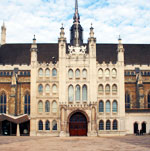
The Guildhall, the City of London's medieval city hall, was partlydestroyed in the 'Great Fire of London' in 1666 and subsequently restored in 1670, 1788, 1910 and, after being damaged during World War II, in 1954

FRONT PAGE
About us
 

UK politics: London prepares for 2016 elections
City regions (UK)
City of London Corporation
London government
British Mayors
Mayor of London
England's mayors assessed
Localis: Learning from Europe
UK local government
Mayors in Europe
Gibraltar government
London elections 2012

Worldwide | Elections | North America | Latin America | Europe | Asia | Africa |


 




 













|
|
The City of London offers on one square mile
history, feudal governance and global finance
By Andrew Stevens
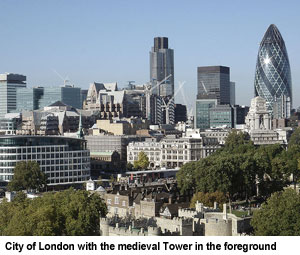
12 August 2014: The landmarks of the area covered by the historic City of London Corporation are known to many – St Paul’s Cathedral, the Old Bailey, the ‘Gherkin’ and soon the ‘Walkie-Talkie’ and the ‘Cheesegrater’, to name but few – but less is known about the Corporation itself. The City of London is often confused with Greater London (the area covered by the Greater London Authority), but the two concepts are indeed very distinct and separate.
The City of London Corporation: Complete 2022 update
The City of London relates to the historic ‘square mile’ at the geographic centre of the region of Greater London. It is only one of 33 local authorities in Greater London, the other 32 being known as London Boroughs. For this, and several other reasons, local government structures in London (both the city and region – often referred to as “the capital”, though this term is technically meaningless) are very anomalous.
History
The area of the City of London was first settled by the Romans and is governed by the City of London Corporation, which acts as the local authority for its jurisdiction. Gradually, the City of London established itself as the ‘capital’ of England, though Parliament and the Civil Service are all based in the neighbouring City of Westminster. The Corporation and its practices have their origins as far back as 1111, it regards itself as “the oldest local authority in England”. Its status as the first independent local authority came about through the city’s role as the centre of finance and trade in England, it was seen as so important to the national interest that it was given considerable autonomy by the monarch.
In Saxon times, the city was governed by a Court of Husting, with Aldermen (meaning ‘elders’ in Saxon) deciding on the city’s administrative and judicial affairs. This later became the Court of Aldermen and in 1189 the city gained its first Lord Mayor – the post-holder being the city’s figurehead and chief official. The Court of Aldermen began to assemble a body of ordinary citizens from each of the city’s wards and in 1376 this body was formally constituted as the Court of Common Council and in 1384 was directly elected from the city’s wards. The Court of Common Council accumulated the powers of a local authority as the Court of Aldermen’s role diminished. The Court of Common Council and the Lord Mayor remain the two key elements of local administration in the city to this day. The city is relatively unusual in the British system insofar as the elections to the Court of Common Council are mainly non-party political.
The city avoided the wide reaching reorganisations of municipal government in Greater London in 1899 and 1965. Indeed, in the mid-nineteenth century, much-needed reform of the metropolitan area outside of the city’s boundaries (which eventually became the London County Council) was deferred for at least 20 years because the city feared that it may be included in the reform plans. Tradition and pageantry is integral to the City of London Corporation’s function, with the Court of Aldermen and the Lord Mayor performing judicial and administrative functions to this day, as well as their ceremonial duties. In addition, the Livery Companies (historical guilds of trades, both ancient and modern) play a formal role in the Corporation’s work. Because the city is primarily a business district with few residents, it is argued that the usual rules concerning the need for properly constituted elected local government, like in any other London Borough, do not apply. It is for this reason, and the retained presence of the ornate and dated local institutions (elected on a non-party basis), that the City of London is regarded as both complex and unique in the world.
 FAQs FAQs
How is the City of London Corporation governed?
The City of London Corporation is based on a very old model of governance which has its origins in feudal times, many aspects of which survive to this day, though they are occasionally amended to adapt to modern times.
The principal decision-making body within the Corporation’s governing structures is the Court of Common Council. This has a membership of 100 members, elected directly from the City’s 25 wards. It meets every four weeks, though its committees meet more regularly. There are many committees of the Court of Common Council – Policy and Resources, Finance, Education, Planning and Transportation etc. as well as a number serving the City’s individual schools. Several of the committees (Education, for instance) have co-opted members serving on them, but these hold their membership through specialist expertise and have no other voting rights within the Corporation. The acknowledged ‘leader’ of the Corporation, other than its historic Lord Mayor, is the Chairman of the Policy and Resources Committee, who is generally called upon to represent the body to the media etc.
To be eligible to stand for election, candidates must be Freemen of the City of London (a minor titular honour, recipients are nominated by one of the City’s livery companies – these being guilds of medieval origin) and listed on the electoral roll of the City. Elections are on a non-political basis – it is possible to stand for election and be nominated by a political party, but this practice is discouraged and instances of it are very rare, with the first ever (Labour) party candidate elected in 2014.
In addition, there is a Court of Aldermen. There are 25 Aldermen, one elected from each ward. Over time, the role and significance of the office of Alderman has diminished and today officeholders discharge minor judicial functions within the City as magistrates and are allowed to sit on the committees of the Court of Common Council.
There are no allowances payable to either Aldermen or members of the Court of Common Council.
How did people vote in the City’s elections before the recent reforms?
The previous electoral arrangements for the City of London Corporation have, like all other aspects of the Corporation, evolved since the medieval period. The crux of the system is that the City’s 7,500 residents possess a vote, as they would in any other British local authority, but all sole traders and partnerships (‘unincorporated firms’) based in the City were also accorded voting rights (commonly referred to as ‘the business vote’). Businesses excluded from voting included companies limited by guarantee (‘incorporated firms’), both public and private, despite their preponderance within the City. Because of the nature of British company law, firms of accountants and solicitors tend to be based on the partnership model and as such these were dominant in the business vote. The minimum requirement is that the businesses own or rent property within the City that has a rateable value of at least £10 (this figure was set in the 19th century). Votes accorded to unincorporated firms were on the basis of the number of employees working for the business.
How are people/business bodies given their votes now?
The reforms pursued by the City of London Corporation have had the effect of allowing the companies limited by guarantee (incorporated firms) to become part of the business vote. This means that the total franchise for the City of London Corporation is now approximately 32,000 voters, as an increased number of electors nominated by incorporated firms and other corporate bodies (e.g. churches and charities) are added to it.
There has been no change to the method by which residents vote (see notes on ward boundaries however). The reforms mean that all firms and organisations recognised by UK company or charity law that physically work from the City of London, are entitled to nominate electors for the ward in which they are based. The way in which electors are allocated according to the size of the company or organisation is designed to prevent large companies from dominating the elections. The system by which electors are chosen by the company is reserved for the company itself, though the electors must be eligible to vote in public elections as according to UK law (i.e. over 18 and an EU or Commonwealth citizen) and the firms may not direct or ‘mandate’ which way their electors vote. The electors (including residents) are then grouped together in one of the City’s 25 wards.
What was the impetus behind the reforms?
The City of London Corporation has, for two centuries, been resistant to any moves to reform local governance in Greater London. It has traditionally been left untouched by any reform of local government in the capital. However, the creation of the Greater London Authority in 2000 meant that some degree of reform to the City was overdue and necessary. The Corporation claims to have pursued options for modernisation of its practices for at least the last 15 years, including how Melbourne City Council in Australia uses business votes in its elections. However, reform of the City of London Corporation was on the national political agenda, and without its own proposals for reform, it was more than likely that national government would have stepped in and legislated for reform itself.
The City of London Corporation have claimed that the reforms were in response to political pressure within and outside the City and are also based on a desire to widen the business vote to take in those firms that were excluded by the rule on incorporated firms not being allowed to vote. It was to reflect the fact that the City is the leading finance centre in Europe and to give the businesses that chose to locate there more of a say in the running of the City’s local services (there are 300,000 people working in the City but only 7,500 residing there).
What are the main aspects of the recent reforms?
The main purpose of the reforms initiated by the City of London Corporation was to change the voting system for the City to allow businesses a bigger say and fulfil its stated intention to the government to modernise itself. However, in order to do this, it was required to seek an amendment in Parliament to existing law on elections in the City. To this end, it promoted a Private Bill in Parliament (a Private Bill is one sponsored by a body such as a local authority) which received government support. The City of London (Ward Elections) Act was signed into law in November 2002. Its aim, according to the City of London, was to bring about the modernisation and improvement of the existing voting system and to extend the system to an increased number of bodies entitled to participate.
The City of London Corporation presented the Bill to Parliament in November 2002. It was considered by the House of Commons in February 1999 and April 2002, before the House of Lords finally considered it in June 2002. The debate in Parliament concerned the need to modernise the City’s electoral system, but there was some legislators who felt that the business vote element should be removed and the City subject to normal public elections like any other local authority in Britain.
What prospects are there for future reform?
Traditionally the City of London Corporation has proved to be quite adept at getting reform deferred, or even obstructed, and recent limited reforms have demonstrated this to be the case still. In spite of longstanding prior commitments to making the corporation’s council elected solely by City residents, in 1996 the Labour Party diluted its proposals and offered to work with the corporation on a more limited reform to the franchise, culminating in the recent reforms. In May 2006, the then Labour government suggested during a parliamentary debate that a further reform might be considered after the City elections in 2009, possibly involving some form of ‘commuter’ vote to recognise the limited number of residents able to vote there but broadening participation by offering it to those who work in the City. In the elections, the local Labour Party shattered centuries of tradition by fielding candidates under its party banner, as a means to highlight the need for reform, especially following the onset of the global financial crisis. Scrutiny of the City’s affairs and governance is now particularly acute, especially after the Occupy protests, with an organised City Reform Group campaigning for increased democratic oversight of the corporation.
|
|

|
