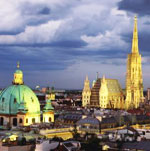
 Mercer Consulting has named Vienna as the 'best city' in the world.  FRONT PAGE Site Search About us     EIU: Best cities in the world Mercer: Best cities in the world Richest cities in the world Secure cities Urban population growth from now to 2030 World's largest cities and their mayors 2010 Most expensive world cities  Worldwide | Elections | North America | Latin America | Europe | Asia | Africa |                           |
The best cities in the world for
|
|
2012 Rank
|
2011 Rank
|
City
|
Country
|
|
1
|
1
|
Vienna | Austria |
|
2
|
2
|
Zurich | Switzerland |
|
3
|
3
|
Auckland | New Zealand |
|
4
|
4
|
Munich | Germany |
|
5
|
5
|
Vancouver | Canada |
|
6
|
=5
|
Düsseldorf | Germany |
|
7
|
7
|
Frankfurt | Germany |
|
8
|
8
|
Geneva | Switzerland |
|
9
|
=9
|
Copenhagen | Denmark |
|
=10
|
9
|
Bern | Switzerland |
|
=10
|
11
|
Sydney | Australia |
|
12
|
12
|
Amsterdam | Netherlands |
|
13
|
13
|
Wellington | New Zealand |
|
14
|
14
|
Ottawa | Canada |
|
15
|
15
|
Toronto | Canada |
|
16
|
17
|
Berlin | Germany |
|
=17
|
16
|
Hamburg | Germany |
|
=17
|
18
|
Melbourne | Australia |
|
=19
|
19
|
Luxembourg | Luxembourg |
|
=19
|
20
|
Stockholm | Sweden |
|
21
|
21
|
Perth | Australia |
|
22
|
=22
|
Brussels | Belgium |
|
23
|
=22
|
Montreal | Canada |
|
24
|
24
|
Nürnberg | Germany |
|
25
|
25
|
Singapore | Singapore |
|
26
|
=26
|
Canberra | Australia |
|
27
|
28
|
Stuttgart | Germany |
|
28
|
29
|
Honolulu | USA |
|
=29
|
=30
|
Adelaide | Australia |
|
=29
|
=30
|
Paris | France |
|
=29
|
=30
|
San Francisco | USA |
|
=32
|
=33
|
Calgary | Canada |
|
=32
|
35
|
Helsinki | Finland |
|
=32
|
=33
|
Oslo | Norway |
|
=35
|
36
|
Boston | USA |
|
=35
|
=26
|
Dublin | Ireland |
|
37
|
37
|
Brisbane | Australia |
|
38
|
38
|
London | UK |
|
39
|
39
|
Lyon | France |
|
40
|
40
|
Barcelona | Spain |
|
41
|
42
|
Milan | Italy |
|
42
|
=43
|
Chicago | USA |
|
43
|
=43
|
Washington DC | USA |
|
=44
|
41
|
Lisbon | Portugal |
|
=44
|
47
|
New York City | USA |
|
=44
|
48
|
Seattle | USA |
|
=44
|
46
|
Tokyo | Japan |
|
48
|
=49
|
Kobe | Japan |
|
=49
|
=43
|
Madrid | Spain |
|
=49
|
=49
|
Pittsburgh | USA |
|
=49
|
=49
|
Yokohama | Japan |
The EIU's list of 'best' cities in the world
Follow @City_Mayors
The Americas
Canadian cities still dominate the top of the index for this region, with Vancouver (5) retaining the top regional spot, followed by Ottawa (14), Toronto (15) and Montreal (23). Calgary ranks 32 on the overall quality of living ranking. Overall, there was almost no movement in rankings among Canadian cities from 2011 to 2012, with Calgary advancing one position, Montreal retreating one position, and the other cities remaining unchanged.
Honolulu (28) is the US city with the highest quality of living, followed by San Francisco (29) and Boston (35). Chicago is at 42 and Washington, DC ranks 43. New York – the base city – ranks 44. In Central and South America, Pointe-à-Pitre, Guadeloupe ranks the highest for quality of living at 63. San Juan, Puerto Rico follows at 72 and Montevideo, Uruguay at 77. Port-au-Prince, Haiti (219) ranks lowest in the region.
A spokesman for Mercer said: “Overall, there has been little change in the rankings for North American cities. A number of South and Central American countries have experienced positive change, essentially due to some modest infrastructural and recreational improvement. Nevertheless, political and security issues, along with natural disasters, continue to hamper the quality of living in South and Central American cities. High crime levels also remain a major problem.”
In terms of city infrastructure, Vancouver (9) tops the ranking for the region with Atlanta and Montreal following at 13. Other Canadian cities that ranked highly were Toronto (16) and Ottawa (25). In the United States, Dallas ranked 15, followed by Washington, DC (22), Chicago (28) and New York (30). Buenos Aires, Argentina (83) has the best city infrastructure in Central and South America, whereas Port-au-Prince is the lowest ranking at 221.
Europe
Europe has 15 cities among the world’s top 25 cities for quality of living. Vienna retains the highest-ranking for both the region and globally. The rest of the top 10 for Europe are dominated by German and Swiss cities, with three cities each in the top 10. Zurich (2) is followed by Munich (4), Düsseldorf (6), Frankfurt (7), Geneva (8), Copenhagen (9) and Bern (10). The lowest-ranking Western European cities are Athens (83) and Belfast (64). Apart from London, there are no UK cities in the top 50.
Other European cities among the top 25 include Amsterdam (12), Berlin (16), Hamburg (17), Luxembourg (19), Stockholm (19), Brussels (22) Nürnberg (24) and Stuttgart (27). Paris ranks 29 and is followed by Helsinki (32), Oslo (32) and London (38). Dublin dropped nine places from last year to rank 35, mostly due to a combination of serious flooding and an increase in crime rates. Lisbon ranks 44 followed by Madrid (49) and Rome (52). Prague, Czech Republic (69) is the highest-ranking Eastern European city followed by Budapest, Hungary (74); Ljubljana, Slovenia (75); Vilnius, Lithuania (79); and Warsaw, Poland (84). The lowest-ranking European city is Tbilisi, Georgia (213).
With six cities in the top 10, European cities also fare well in the city infrastructure ranking. Frankfurt and Munich rank the highest at second place, followed by Copenhagen (4) and Düsseldorf (5). London (6) and Hamburg (9) are followed by Paris which ranks 12. Budapest (67) is the highest-ranking for city infrastructure in Eastern Europe followed by Vilnius (74) and Prague (75), whereas Yerevan (189) and Tbilisi (201) rank lowest.
“Infrastructure in German and Danish cities is among the best in the world, in part due to their first-class airport facilities, international and local connectivity, and a high standard of public services,” said Mr. Parakatil. “London’s high ranking in the infrastructure index reflects a combination of high level of public services offered, with its extensive public transportation system including airports, the London Underground buses and railroad services.”
Asia-Pacific
Auckland (3) retains its position as the highest-ranking city for quality of living in the region. Sydney follows at 10, Wellington at 13, Melbourne at 17 and Perth at 21. Singapore remains the highest-ranking Asian city at 25 followed by Japanese cities Tokyo (44), Kobe (48), Yokohama (49) and Osaka (57). Hong Kong (70), Seoul (75), Kuala Lumpur (80), Taipei (85) and Shanghai (95) are other major Asian cities ranked in the top 100. The region’s lowest-ranking cities are Dhaka, Bangladesh (203); Bishkek, Kyrgyzstan (204); and Dushanbe, Tajikistan (207).
For city infrastructure, Singapore has the highest ranking worldwide followed by Hong Kong (6), Sydney (8), Perth (25), Tokyo (32) and Melbourne (34). Adelaide and Brisbane both ranked 37. Nagoya (41), Auckland (43), Kobe (44), Wellington (48), Seoul (50) and Osaka (51) are the next highest-ranking cities in this region. The region’s lowest-ranking city for city infrastructure is Dhaka, Bangladesh (205).
According to Mercer, a noticeable gap can be seen among Asia Pacific cities where several cities have improved in the region partly because they have been investing massively in infrastructure and public services. "Competition among municipalities has been continuously increasing in order to attract multinationals, foreigners, expatriates and tourists. Yet a considerable number of Asian cities rank in the bottom quartile, mainly due to high political volatility, poor infrastructure and obsolete public services,” a spokesman said.
Middle East and Africa
Dubai (73) and Abu Dhabi (78) in the United Arab Emirates are the region’s cities with the best quality of living. Port Louis in Mauritius (82), Cape Town (89) and Johannesburg (94) follow, and along with Victoria in the Seychelles (96) and Tel Aviv (99), are the region’s only other cities in the top 100. This region has 15 cities in the bottom 20, including Lagos, Nigeria (202); Bamako, Mali (209); Khartoum, Sudan (217); and N’Djamena, Chad (218). Baghdad, Iraq (221) is the lowest-ranking city both regionally and globally.
In the city infrastructure index, most of the region’s cities rank below 100. The exceptions are Dubai (34), which ranks the highest in the region for city infrastructure, Tel Aviv (58), Abu Dhabi (72), Port Louis (91), Muscat (94), Cairo (95) and Cape Town (97). Port Louis, Cairo and Cape Town are the only African cities in the top 100. Elsewhere in the region, Doha, Qatar is at 102, Tunis, Tunisia, ranks 103 and Manama, Bahrain is at 110. In terms of city infrastructure, Baghdad, Iraq (220) is the lowest-ranking city regionally, along with Sana’a, Yemen (219); Brazzaville, Congo (218); Kigali, Rwanda (217); and Abuja, Nigeria (215).
“The ongoing turmoil in many countries across North Africa and the Middle East has led to serious security issues for locals and expatriates,” said a spokesman for Mercer. “Many countries continue to experience violence through political demonstrations that have sometimes developed into massive uprisings and led to serious instability within the region. Countries such as Syria and Mali have seen their quality of living levels drop substantially.”
The cities with the best infrastructure
|
Rank
|
City
|
Country
|
|
1
|
Singapore | Singapore |
|
2
|
Frankfurt | Germany |
|
2
|
Munich | Germany |
|
4
|
Copenhagen | Denmark |
|
5
|
Düsseldorf | Germany |
|
=6
|
Hong Kong | Hong Kong |
|
=6
|
London | UK |
|
8
|
Sydney | Australia |
|
=9
|
Hamburg | Germany |
|
=9
|
Vancouver | Canada |
|
11
|
Yokohama | Japan |
|
12
|
Paris | France |
|
=13
|
Atlanta, GA | USA |
|
=13
|
Montreal | Canada |
|
15
|
Dallas | USA |
|
=16
|
Toronto | Canada |
|
=16
|
Vienna | Austria |
|
=18
|
Helsinki | Finland |
|
=18
|
Oslo | Norway |
|
=18
|
Stockholm | Sweden |
|
=18
|
Stuttgart | Germany |
|
22
|
Washington DC | USA |
|
23
|
Amsterdam | Netherlands |
|
24
|
Zurich | Switzerland |
|
=25
|
Bern | Switzerland |
|
=25
|
Ottawa | Canada |
|
=25
|
Perth | Australia |
|
28
|
Chicago | USA |
|
29
|
Berlin | Germany |
|
30
|
New York City | USA |
|
31
|
Boston | USA |
|
32
|
Tokyo | Japan |
|
33
|
Nurnberg | Germany |
|
=34
|
Dubai | UAE |
|
=34
|
Madrid | Spain |
|
=34
|
Melbourne | Australia |
|
=37
|
Adelaide | Australia |
|
=37
|
Brisbane | Australia |
|
=37
|
Philadelphia | USA |
|
40
|
Honolulu | USA |
|
41
|
Nagoya | Japan |
|
42
|
Brussels | Belgium |
|
43
|
Auckland | New Zealand |
|
=44
|
Birmingham | UK |
|
=44
|
Glasgow | UK |
|
=44
|
Kobe | Japan |
|
47
|
Geneva | Switzerland |
|
48
|
Miami, FL | USA |
|
48
|
Wellington | New Zealand |
|
50
|
Seoul | South Korea |
Research methodology
Mercer Consulting largely between September and November 2012 and is regularly updated to take account of changing circumstances. In particular, the assessments are revised in the case of significant political, economic and environmental developments.
Mercer evaluates local living conditions in all the 460 cities it surveys worldwide. Living conditions are analysed according to 39 factors, grouped in 10 categories:
1) Political and social environment (political stability, crime, law enforcement, etc)
2) Economic environment (currency exchange regulations, banking services, etc)
3) Socio-cultural environment (censorship, limitations on personal freedom, etc)
4) Health and sanitation (medical supplies and services, infectious diseases, sewage, waste disposal, air pollution, etc)
5) Schools and education (standard and availability of international schools, etc)
6) Public services and transportation (electricity, water, public transport, traffic congestion, etc)
7) Recreation (restaurants, theatres, cinemas, sports and leisure, etc)
8) Consumer goods (availability of food/daily consumption items, cars, etc)
9) Housing (housing, household appliances, furniture, maintenance services, etc)
10) Natural environment (climate, record of natural disasters)
The scores attributed to each factor allow for city-to-city comparisons. The result is a quality-of-living index that compares relative differences between any two locations. For the indices to be used effectively, Mercer has created a grid that allows users to link the resulting index to a quality-of-living allowance amount by recommending a percentage value in relation to the index.
Follow @City_Mayors