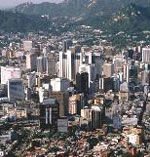
With a population of more than 10 million, Seoul is one of the largest cities in the world

FRONT PAGE
Site Search
About us | Quiénes somos |
A propos de nous | Über uns |
Mayor Monitor
Directories
Events
Debate

Mayors from Asia
Mayors from The Americas
Mayors from Europe
Local government in The Americas:
| Argentina | Bolivia | Brazil | Canada | Caribbean | Chile | Mexico | Peru | USA | Venezuela |
Local government in Europe:
| Albania | Cyprus | France | Germany | Gibralta | Greece | Iceland | Ireland | Italy | Kosovo | Malta | Portugal | Russia | Spain | UK1 | UK2 |
Local government in Asia and Australia
| Australia | China | India | Indonesia | Japan | Malaysia | Philippines | Singapore | South East Asia | South Korea | Thailand | Turkey |
Local government in Africa
| South Africa |
South Korean local elections 2006
Federated local government
Multi-tier local government
Karachi local government system
Local government mergers

City Mayors reports news from towns and cities around the world. Worldwide | Elections | North America | Latin America | Europe | Asia | Africa | Events |

Mayors from The Americas, Europe. Asia, Australia and Africa are competing for the annual World Mayor Award. More

City Mayors ranks the world’s largest as well as richest cities and urban areas. It also ranks the cities in individual countries, and provides a list of the capital cities of some 200 sovereign countries. More

City Mayors reports political events, analyses the issues and depicts the main players. More

City Mayors describes and explains the structures and workings of local government in Europe, The Americas, Asia, Australia and Africa. More

City Mayors profiles city leaders from around the world and questions them about their achievements, policies and aims. More

City Mayors deals with economic and investment issues affecting towns and cities. More

City Mayors reports on how business developments impact on cities and examines cooperation between cities and the private sector. More

City Mayors describes and explains financial issues affecting local government. More

City Mayors lists and features urban events, conferences and conventions aimed at urban decision makers and those with an interst in cities worldwide. More

City Mayors reports urban environmental developments and examines the challenges faced by cities worldwide. More

City Mayors reports on and discusses urban development issues in developed and developing countries. More

City Mayors reports on developments in urban society and behaviour and reviews relevant research. More

City Mayors deals with urban transport issues in developed and developing countries and features the world’s greatest metro systems. More

City Mayors examines education issues and policies affecting children and adults in urban areas. More

City Mayors investigates health issues affecting urban areas with an emphasis on health in cities in developing countries. More

City Mayors examines the importance of urban tourism to city economies. More

City Mayors examines the contributions history and culture make to urban society and environment. More

City Mayors describes the history, architecture and politics of the greatest city halls in the world. More

City Mayors invites readers to write short stories about people in cities around the world. More

City Mayors questions those who govern the world’s cities and talks to men and women who contribute to urban society and environment. More

City Mayors profiles national and international organisations representing cities as well as those dealing with urban issues. More

City Mayors reports on major national and international sporting events and their impact on cities. More

City Mayors lists cities and city organisations, profiles individual mayors and provides information on hundreds of urban events. More
Local government in South Korea
Seoul Mayor first among equals
in South Korea local government
Andrew Stevens, Deputy Editor
29 December 2008: Though external perceptions are largely moulded by the continuing divide between it and its Communist neighbour in the north, the Republic of Korea is highly urbanised and possesses a well-developed system of local government based on both history and utility. However, reform is very much on the agenda, with moves to replace the current three-tiered structure with a city-orientated two-tier system.
Modern politics in South Korea have understandably developed under the shadow of its hostile neighbour and former constituent part in the north, though it finds itself today as a stable liberal democracy and respected actor in East Asia. Following the end of the Korean war in 1953, Syngman Rhee’s regime remained in place, having taken over from the US occupying forces on the southern half of the Korean peninsula.
Having avoided removal from power by protests in 1960, Rhee’s authoritarian regime was replaced by a short-lived government under the auspices of Yun Po Sun’s Democratic Party, who was himself removed by a military coup the following year. Major-General Park Chung Hee then remained military ruler until his assassination in 1979.
Park’s still controversial period of office was marked by rapid economic growth and the resumption of normal diplomatic relations with neighbouring Japan. The subsequent military regime of Chun Doo-hwan, remembered for the military crackdown against student protestors leading to the Gawngju massacre in 1980, remained in place until the resumption of democratic rule in 1987. Today, the Republic of Korea is a liberal democracy governed by an executive president elected by the popular vote every five years and a unicameral 299-member National Assembly elected by proportional representation every four years.
Taken at the most primitive level of consideration, South Korea is divided into nine provinces (‘do’), which are then divided into counties (‘gun’). However, the weighting system designed to recognise large urban centres has reorganised this system into an array of units, with six metropolitan cities (‘gwangyeoksi’) such as Busan (the largest other than the capital Seoul) and ordinary cities (‘si’) which are counties which have attained a population of 150,000 or more. The three cities with more than 500,000 inhabitants are then divided into wards (‘gu’), the rest into neighbourhood areas (‘dong’). The counties outside of the urban conurbations are subdivided into either towns (‘eup’) or districts (‘myeon’), with towns having 20,000 or more inhabitants. Both towns and districts are subdivided into villages (‘ri’).
South Korea has only one special city (‘teukbyeolsi’), the capital Seoul, which is then itself divided into 25 wards and a further 522 neighbourhoods. The wards became autonomous in 1988 and have elected their own mayors since 1995. The metropolitan area of Seoul contains 10.3m people and is ranked 22nd most densely populated in the world. The South Korean government has announced plans to relocate the capital outside of the city of Seoul but this has been the matter of considerable controversy and a Supreme Court ruling has declared it unconstitutional. The Seoul Metropolitan Government is based on the office of the elected Mayor, who is currently Oh Se-hoon, elected in 2006. The mayor appoints three vice mayors to supervise the city administration, as well several assistant mayors. The legislative branch consists of the 104-member Metropolitan Council, elected every four years.