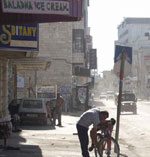
With a population of 57,000, Ramallah is one of Palestine's most important cities

FRONT PAGE
SiteSearch
About us
Directories

Palestine elections
Iranian local elections 2006
Saudi municipal elections
Middle East women in politcs
Karachi local government structure
Nepalese rebellion
Philippines propose to cancel elections

City Mayors reports news from towns and cities around the world. Worldwide | Elections | North America | Latin America | Europe | Asia | Africa | Events |

Mayors from The Americas, Europe. Asia, Australia and Africa are competing for the annual World Mayor Award. More

City Mayors ranks the world’s largest as well as richest cities and urban areas. It also ranks the cities in individual countries, and provides a list of the capital cities of some 200 sovereign countries. More

City Mayors lists and features urban events, conferences and conventions aimed at urban decision makers and those with an interst in cities worldwide. More

City Mayors reports political events, analyses the issues and depicts the main players. More

City Mayors describes and explains the structures and workings of local government in Europe, The Americas, Asia, Australia and Africa. More

City Mayors profiles city leaders from around the world and questions them about their achievements, policies and aims. More

City Mayors deals with economic and investment issues affecting towns and cities. More

City Mayors reports on how business developments impact on cities and examines cooperation between cities and the private sector. More

City Mayors describes and explains financial issues affecting local government. More

City Mayors reports urban environmental developments and examines the challenges faced by cities worldwide. More

City Mayors reports on and discusses urban development issues in developed and developing countries. More

City Mayors reports on developments in urban society and behaviour and reviews relevant research. More

City Mayors deals with urban transport issues in developed and developing countries and features the world’s greatest metro systems. More

City Mayors examines education issues and policies affecting children and adults in urban areas. More

City Mayors investigates health issues affecting urban areas with an emphasis on health in cities in developing countries. More

City Mayors examines the contributions history and culture make to urban society and environment. More

City Mayors examines the importance of urban tourism to city economies. More

City Mayors describes the history, architecture and politics of the greatest city halls in the world. More

City Mayors invites readers to write short stories about people in cities around the world. More

City Mayors questions those who govern the world’s cities and talks to men and women who contribute to urban society and environment. More

City Mayors profiles national and international organisations representing cities as well as those dealing with urban issues. More

City Mayors reports on major national and international sporting events and their impact on cities. More

City Mayors lists cities and city organisations, profiles individual mayors and provides information on hundreds of urban events. More
Palestine is adamant: Hamas will take
part in municipal and general elections
By Daoud Kuttab, Arabic Media Internet Network
26 October 2005: Major Palestinian cities, like Nablus, Ramallah, Hebron, Gaza, Jenin, Rafah, are due to elect mayors and city councils in December 2005. The following month, the entire Palestinian public is due to elect a new legislative council. The city elections will be the first since 1976, legislative elections are the first since 1995. All city mayors in office today are appointed rather than elected. Legislators have been in office for ten years.
While municipal elections are generating interest in the major cities, it is the legislative elections that are the centre of focus, for two important reasons. This is the first time that the Islamic groups (predominantly Hamas) agree to participate in these elections, and they will be mixed. Palestinians will vote using two papers: one to choose 66 members based on district representation, and an equal number to be chosen based on party lists. The latter will be closely watched throughout the Arab world; they will be strengthening political parties and give credence to some of the smallest parties. Using this proportional representation will allow small parties, which might not be able to get a single candidate chosen in a particular district but a combination of votes from all over Palestine, to have a member or two from their party elected.
The pioneering nature of the elections, unfortunately, is not what has grabbed the headlines, but rather the fact that Hamas (as well as Islamic Jihad) plans to participate in the elections. Israeli opposition has varied from calls that any party participating in the elections recognise Israel first to calls for disarming the Islamic groups.
Palestinian officials, as well as the public at large, have been entirely supporting Hamas' right to participate in the elections. For years Palestinians have been trying to convince Hamas and Islamic Jihad to try and channel their energies through the ballot box and not through the bullet. In fact this is the exact terminology that Shimon Peres used in the past trying to encourage political empowerment of Palestinian militants.
Hamas has repeatedly rejected participation in the political process, stressing that it legitimises the Oslo process, which it opposed. But after five years of a military Intifada, which has shown the Islamic militants the limits of military action, moderate elements in Hamas finally prevailed and announced their agreement to participate in the upcoming legislative elections. The election participation was part of an agreement reached in Cairo with the active involvement of the head of the Egyptian intelligence service.
The Palestinian president promised that elections would take place in the summer of 2005; in return, the Islamic groups agreed to tahdia — a unilateral period of quiet. But the elections didn't take place in the summer for a variety of reasons, among which the fact that the election law had not been agreed upon by the legislature and President Mahmoud Abbas had little choice but to postpone the elections till January 2006. The Islamic groups initially protested this postponement but finally accepted it and began preparing for it.
Their success in the initial phase of the municipal elections seems to have worked negatively for them, worrying Israel and Washington. While most observers feel that Hamas and other Islamic candidates are not likely to win more than 30-35 per cent of the vote, Israel demanded that they not be allowed to participate in the elections. This and the fact that Israel has recently begun rounding up political leaders of Hamas (including the moderate Hassan Yousef who publicly accepted the two-state solution along the 1967 borders) is bound to increase the Islamic groups' popularity.
Islamic leaders have repeatedly said that they are not seeking a political coup in the elections but that they are serious about being part of the Palestinian decision-making process.
If the US and Israel want Hamas and Islamic Jihad to participate neither in the military struggle nor in the political arena, what is it that they want them to do?
This issue becomes even more sensitive when taken in the context of US efforts to spread democracy in the greater Middle East and its insistence that its democratic call don't exclude Muslim parties. Arabs and Muslims, as well as Palestinians, will be closely watching how the United States deals with this issue. If it fails this test, it is unlikely that its ideas will have any chance of success in other Arab or Muslim areas.