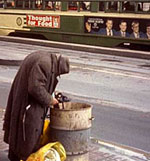
Hunger and homeless is on the rise in American cities (Photo: Jacob Holdt)

FRONT PAGE
Site Search
About us | Quiénes somos |
A propos de nous | Über uns |
Mayor Monitor
Directories
Events
Debate

USA racial profiling
2009 homelessnees in US cities
American domestic migration
US poverty 2011
US urban inequality
US socio-economic trends
Youth curfews in US cities
America's children of prisoners
Gay rights in US cities
Security cameras in US cities
English-only US cities
US mayors silent on racial profiling
Obamas' urban policies
America jails its youth
US gun contol in tatters
Urban crime 2007
Minorities in the US
Black American men
Catholic Church in urban USA
US poverty underestimated
Low-cost clothing to curb inner city violence
US affordable housing crisis
Los Angeles migration
US migration

City Mayors reports news from towns and cities around the world. Worldwide | Elections | North America | Latin America | Europe | Asia | Africa | Events |

Mayors from The Americas, Europe. Asia, Australia and Africa are competing for the annual World Mayor Award. More

City Mayors ranks the world’s largest as well as richest cities and urban areas. It also ranks the cities in individual countries, and provides a list of the capital cities of some 200 sovereign countries. More

City Mayors reports political events, analyses the issues and depicts the main players. More

City Mayors describes and explains the structures and workings of local government in Europe, The Americas, Asia, Australia and Africa. More

City Mayors profiles city leaders from around the world and questions them about their achievements, policies and aims. More

City Mayors deals with economic and investment issues affecting towns and cities. More

City Mayors reports on how business developments impact on cities and examines cooperation between cities and the private sector. More

City Mayors describes and explains financial issues affecting local government. More

City Mayors lists and features urban events, conferences and conventions aimed at urban decision makers and those with an interst in cities worldwide. More

City Mayors reports urban environmental developments and examines the challenges faced by cities worldwide. More

City Mayors reports on and discusses urban development issues in developed and developing countries. More

City Mayors reports on developments in urban society and behaviour and reviews relevant research. More

City Mayors deals with urban transport issues in developed and developing countries and features the world’s greatest metro systems. More

City Mayors examines education issues and policies affecting children and adults in urban areas. More

City Mayors investigates health issues affecting urban areas with an emphasis on health in cities in developing countries. More

City Mayors examines the importance of urban tourism to city economies. More

City Mayors examines the contributions history and culture make to urban society and environment. More

City Mayors describes the history, architecture and politics of the greatest city halls in the world. More

City Mayors invites readers to write short stories about people in cities around the world. More

City Mayors questions those who govern the world’s cities and talks to men and women who contribute to urban society and environment. More

City Mayors profiles national and international organisations representing cities as well as those dealing with urban issues. More

City Mayors reports on major national and international sporting events and their impact on cities. More

City Mayors lists cities and city organisations, profiles individual mayors and provides information on hundreds of urban events. More
Do not handcuff the
poor and homeless
A report by the US National Law Center on Homelessness & Poverty
and the US National Coalition for the Homeless
17 July 2009: The housing and homelessness crisis in the United States has worsened over the past two years, particularly due to the current economic and foreclosure crises. By some estimates, more than 311,000 tenants nationwide have been evicted from homes this year after lenders took over the properties. People being evicted from foreclosed properties and the economic crisis in general have contributed to the growing homeless population. As more people fall into homelessness, local service providers are seeing an increase in the demand for services. In Denver, nearly 30 per cent of the homeless population are newly homeless.
| Types of criminalization | Laws that criminalize | Mean cities | Alternatives to criminalization | Recommendations |
In response to the homelessness crisis the The National Law Center on Homelessness & Poverty (NLCHP) and the National Coalition for the Homeless (NCH) released a report, Homes Not Handcuffs, tracking a growing trend in US cities - the criminalization of homelessness. Of the 25 cities surveyed by the US Conference of Mayors for its annual Hunger and Homelessness Report, 19 reported an increase in homelessness in 2008. 8 On average, cities reported a 12 percent increase. The lack of available shelter space leaves many homeless persons with no choice but to struggle to survive on the streets of our cities.
Even though most cities do not provide enough affordable housing, shelter space, and food to meet the need, many cities use the criminal justice system to punish people living on the street for doing things that they need to do to survive. Such measures often prohibit activities such as sleeping/camping, eating, sitting, and/or begging in public spaces and include criminal penalties for violation of these laws. Some cities have even enacted food sharing restrictions that punish groups and individuals for serving homeless people. Many of these measures appear to have the purpose of moving homeless people out of sight, or even out of a given city.
Types of criminalization measures
The criminalization of homelessness takes many forms, including:
• Enactment and enforcement of legislation that makes it illegal to sleep, sit, or store personal belongings in public spaces in cities where people are forced to live in public spaces.
• Selective enforcement of more neutral laws, such as loitering, jaywalking, or open container laws, against homeless persons.
• Sweeps of city areas in which homeless persons are living to drive them out of those areas, frequently resulting in the destruction of individuals’ personal property such as important personal documents and medication.
• Enactment and enforcement of laws that punish people for begging or panhandling in order to move poor or homeless persons out of a city or downtown area.
• Enactment and enforcement of laws that restrict groups sharing food with homeless persons in public spaces.
• Enforcement of a wide range of so-called “quality of life” ordinances related to public activities and hygiene (i.e. public urination) when no public facilities are available to people without housing.
Laws that criminalize homelessness and poverty
City ordinances frequently serve as a prominent tool for criminalizing homelessness. Of the 235 cities surveyed for our prohibited conduct chart:
• 33 per cent prohibit “camping” in particular public places in the city and 17 per cent have citywide prohibitions on “camping.”
• 30 per cent prohibit sitting/lying in certain public places.
• 47 per cent prohibit loitering in particular public areas and 19 per cent prohibit loitering citywide.
• 47 per cent prohibit begging in particular public places; 49 per cent prohibit aggressive panhandling and 23 per cent have citywide prohibitions on begging.
The trend of criminalizing homelessness continues to grow. Based on information gathered about the 224 cities that were included in our prohibited conduct charts in both our 2006 report and this report:
• There has been a 7 per cent increase in laws prohibiting “camping” in particular public places.
• There has been an 11 per cent increase in laws prohibiting loitering in particular public places.
• There has been a 6 per cent increase in laws prohibiting begging in particular public places and a 5 per cent increase in laws prohibiting aggressive panhandling.
Examples of ‘mean cities’
Since the beginning of 2007, among others documented in this report, measures taken in the following cities stand out as some of the worst examples of cities’ inhumane treatment of homeless and poor people:
• Los Angeles, CA. According to a study by UCLA released in September 2007, Los Angeles was spending $6 million a year to pay for fifty extra police officers as part of its Safe City Initiative to crack down on crime in the Skid Row area at a time when the city budgeted only $5.7 million for homeless services. Advocates found that during an 11-month period 24 people were arrested 201 times, with an estimated cost of $3.6 million for use of police, the jail system, prosecutors, public defenders and the courts. Advocates asserted that the money could have instead provided supportive housing for 225 people. Many of the citations issued to homeless persons in the Skid Row area were for jaywalking and loitering -- “crimes” that rarely produce written citations in other parts of Los Angeles.
• St. Petersburg, FL. Since early 2007, St. Petersburg has passed 6 new ordinances that target homeless people. These include ordinances that outlaw panhandling throughout most of downtown, prohibit the storage of personal belongings on public property, and make it unlawful to sleep outside at various locations. In January 2007, the Pinellas-Pasco Public Defender announced that he would no longer represent indigent people arrested for violating municipal ordinances to protest what he called excessive arrests of homeless individuals by the City of St. Petersburg. According to numbers compiled by the public defender’s office, the vast majority of people booked into the Pinellas County Jail on municipal ordinances were homeless individuals from St. Petersburg.
• Orlando, FL. In 2006, the Orlando City Council passed a law that prohibited groups sharing food with 25 or more people in downtown parks covered under the ordinance from doing so more than twice a year. A member of one of the groups that shares food regularly with homeless and poor people in Orlando parks was actually arrested under the ordinance for sharing food. A federal district court found the law unconstitutional; however, the City of Orlando has appealed the decision.
The report Homes Not Handcuffs says these common practices that criminalize homelessness do nothing to address the underlying causes of homelessness. Instead, they drastically exacerbate the problem. They frequently move people away from services. When homeless persons are arrested and charged under these ordinances, they may develop a criminal record, making it more difficult to obtain the employment and/or housing that could help them become self sufficient.
Alternatives to criminalization
While many cities engage in practices that exacerbate the problem of homelessness by criminalizing it, some cities around the country have pursued more constructive approaches. The following examples illustrate more constructive approaches to homelessness:
• Daytona Beach, FL. In order to reduce the need for panhandling, a coalition of service providers, business groups, and the City of Daytona Beach began a program that provides homeless participants with jobs and housing. While in the Downtown Street Team program, participants are hired to clean up downtown Daytona Beach and are provided initially with shelter and subsequently with transitional housing. A number of participants have moved on from the program to other full-time jobs and housing.
• Cleveland, OH. Instead of passing a law to restrict groups that share food with homeless persons, the City of Cleveland has contracted with the Northeast Ohio Coalition for the Homeless to coordinate outreach agencies and food sharing groups to prevent duplication of food provision, to create a more orderly food sharing system, and to provide an indoor food sharing site to groups who wish to use it.
• Portland, OR. As part of its 10-year plan, Portland began “A Key Not a Card,” where outreach workers from five different service providers are able to immediately offer people living on the street permanent housing rather than just a business card. From the program’s inception in 2005 through spring 2009, 936 individuals in 451 households have been housed through the program, including 216 households placed directly from the street.
The report’s recommendations
Instead of criminalizing homelessness, local governments, business groups, and law enforcement officials should work with homeless people, providers, and advocates for solutions to prevent and end homelessness. Cities should dedicate more resources to creating more affordable housing, permanent supportive housing, emergency shelters, and homeless services in general. To address street homelessness, cities should adopt or dedicate more resources to outreach programs, emergency shelter, and permanent supportive housing. Business groups can play a positive role in helping to address the issue of homelessness. Instead of advocating for criminalization measures, business groups can put resources into solutions to homelessness. When cities work with homeless persons and advocate for solutions to homeless instead of punishing those who are homeless or poor, everyone benefits.