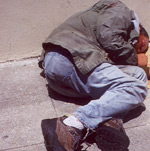
Homeless man on the streets of in New York City

FRONT PAGE
SiteSearch
About us
Directories

American cities of violence
COVID-19 hits African Americans hardest
Police killings of Black Americans
US mayors fight inequality
US poverty underestimated
Poverty in US cities
US mayors fight against guns
US poverty 2011
US urban inequality
Vision for metro America
US abortion debate
US metro 2010
Non-profits vital to urban USA
2009 homelessnees in US cities
US prison closures - Cities
US clergy and local politics
US socio-economic trends
US cities in crisis - for now
Youth curfews in US cities
US mayors silent on racial profiling
Obamas' urban policies
NYC Mayor to tackle poverty
Catholic Church in urban USA
America jails its youth
Minorities in the US
Black American men
US cities and the Iraq war
Failed US immigration reform
Low-cost clothing to curb inner city violence
America's children of prisoners
US affordable housing crisis
Los Angeles migration
US migration
US cities and illegal immigrants
US population reaches 300m
Nonprofits versus US cities
New York's hidden poverty
NYC mayor's welfare policies
USA: Demolition as planning tool
US cities on the internet

City Mayors reports news from towns and cities around the world. Worldwide | Elections | North America | Latin America | Europe | Asia | Africa | Events |

Mayors from The Americas, Europe. Asia, Australia and Africa are competing for the annual World Mayor Award. More

City Mayors ranks the world’s largest as well as richest cities and urban areas. It also ranks the cities in individual countries, and provides a list of the capital cities of some 200 sovereign countries. More

City Mayors reports political events, analyses the issues and depicts the main players. More

City Mayors describes and explains the structures and workings of local government in Europe, The Americas, Asia, Australia and Africa. More

City Mayors profiles city leaders from around the world and questions them about their achievements, policies and aims. More

City Mayors deals with economic and investment issues affecting towns and cities. More

City Mayors reports on how business developments impact on cities and examines cooperation between cities and the private sector. More

City Mayors describes and explains financial issues affecting local government. More

City Mayors lists and features urban events, conferences and conventions aimed at urban decision makers and those with an interst in cities worldwide. More

City Mayors reports urban environmental developments and examines the challenges faced by cities worldwide. More

City Mayors reports on and discusses urban development issues in developed and developing countries. More

City Mayors reports on developments in urban society and behaviour and reviews relevant research. More

City Mayors deals with urban transport issues in developed and developing countries and features the world’s greatest metro systems. More

City Mayors examines education issues and policies affecting children and adults in urban areas. More

City Mayors investigates health issues affecting urban areas with an emphasis on health in cities in developing countries. More

City Mayors examines the importance of urban tourism to city economies. More

City Mayors examines the contributions history and culture make to urban society and environment. More

City Mayors describes the history, architecture and politics of the greatest city halls in the world. More

City Mayors invites readers to write short stories about people in cities around the world. More

City Mayors questions those who govern the world’s cities and talks to men and women who contribute to urban society and environment. More

City Mayors profiles national and international organisations representing cities as well as those dealing with urban issues. More

City Mayors reports on major national and international sporting events and their impact on cities. More

City Mayors lists cities and city organisations, profiles individual mayors and provides information on hundreds of urban events. More
Economists question 'official' poverty
statistics used for US mayors' report
By Tony Favro, USA Editor
1 April 2007: In 2006, the US Conference of Mayors formed a task force to address “persistent poverty and middle class erosion” in American cities. The Task Force on Poverty, Work, and Opportunity, chaired by Los Angeles Mayor Antonio Villaraigosa, worked over a year to craft an action plan. In March 2007, the Task Force released a set of recommendations. While the report makes a convincing argument for a national strategy, its figures probably understate the true extent of poverty in the US.
The poverty-fighting proposals by the U.S. Conference of Mayors include:
• Increased investment in high-quality public education, including universal preschool.
• Increased investment in high-quality, life-long workforce training.
• Public incentives to create more banking opportunities in distressed inner cities.
• Increased public investment in the infrastructure of poor urban neighbourhoods.
The recommendations could cost US$23 billion annually to implement.
While the US Conference of Mayors’ report makes a clear and convincing argument for a common national strategy to alleviate poverty, its calculations are based on the official federal poverty rate. The report notes that “more than 37 million people are officially poor today” in the US [italics added]. Many economists believe this “official” number seriously understates the true extent of poverty in the US.
US poverty measurements
The current method used by the federal government to calculate poverty thresholds was designed in the early-1960s as part of President Lyndon Johnson’s War on Poverty. Essentially, It is a measure of severe deprivation – the minimum amount of money needed for subsistence. Poverty thresholds are absolute dollar amounts (e.g., $10, 210 for an individual; $20,650 for a family of four). The thresholds vary by family size, but not by geography. In other words, the same dollar amounts officially define poverty in both low-cost-of-living rural areas and high-cost big cities. Poverty thresholds are adjusted periodically using the Consumer Price Index, a measure of inflation.
The overwhelming consensus of economists, policy analysts, social scientists, and mayors is that the official federal poverty measure is seriously outdated. Most analyses find that a revised poverty calculation would increase the number of Americans classified as poor. Therefore, a major barrier to redefining poverty thresholds is political. US presidents are reluctant to have official poverty numbers revised upward during their terms in office. Another barrier is financial, since expenditures for many federal programs are tied to the official poverty rate – the more poverty, the more the federal government would have to pay into these programs.
The Canadian model
In Canada, America’s neighbour to the north, poverty thresholds are not absolute income levels as they are in the US. They go beyond measuring only society’s most impoverished and most economically deprived and encompass a broader range of economic hardship.
Poverty in Canada is determined by a Low-Income Cut-Off Line, the point at which individuals or families must devote 60 per cent of their annual income to basic necessities such as food, clothing, rent, transportation, insurances, child care, school supplies, and household supplies. Each metro area in Canada has a different Low-Income Cut-Off Line to account for regional differences in the cost of living.
The conceptual and fundamental differences between the American and Canadian poverty measures are striking.
For example, if we used Canada’s Low-Income Cut-Off Line to measure poverty in Rochester, New York – a typical mid-size American city – the poverty rate would not be 25.9 per cent, as officially defined by the US government, but 38.4 per cent.
Using the Canadian standard, New York City’s poverty rate would not be the official 21.2 per cent, but 38.2 per cent.
In San Jose, California – the center of Silicon Valley and the symbol of wealth and power in the US – the poverty rate would leap from 8.8 per cent to 20.9 per cent, when calculated according to the Canadian method.
Conclusion
It is clear that the official federal US poverty measure is woefully outdated.
The application of Canadian methodology to the US situation is not merely an academic exercise. It illustrates that poverty in America goes well beyond the stereotypical image of the homeless vagrant or the drug addict. The new face of American poverty often includes the restaurant dishwasher, office clerk, deli worker, maintenance worker, single working mother with children, and, in some high-cost-of-living cities, the nurse, the firefighter, and the school teacher.
The federal government’s reluctance to acknowledge the extent of economic hardship in the US doesn’t make poverty disappear. As the US Conference of Mayor’s report makes clear, it simply pushes the problem down to the local level and turns financially-strapped mayors into beggars for more federal support.