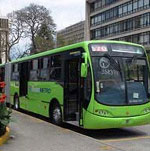
Modern high-quality buses are replacing colourful but uncomfortablde old American school buses

FRONT PAGE
Site Search
About us
 

Barcelona Metro
Berlin U-Bahn
Guangzhou Metro
Guatemala City TransMetro
London Transport
London Underground
Madrid Metro
Mexico City Metrobus
New York City Subway
Paris Métro
Sao Paulo Metro
Seoul Metro
Singapore Metro
Tokyo Metro
Bus Rapid Transport Latin America
Bus Rapid Transport India
Trams in Europe

Worldwide | Elections | North America | Latin America | Europe | Asia | Africa |
























|
|
TransMetro set to end chaotic
commuting in Guatemala City
By Vanessa Plihal, Central America Correspondent
16 June 2007: For Guatemala City’s commuters public transport is in a state of crisis, with daily rampant crimes committed against them inside and outside the city’s antiquated buses. Recklessness by bus drivers adds to the problem. But hopefully, things are set to change.
Guatemalans commute everyday from nearby municipalities and other urban areas to the capital city for their daily activities. Around 68 per cent of them use public transport. The rest have private means. Public transport in the city has been a long and lasting problem. Now, Guatemala City authorities are trying to alleviate the crisis – which it undoubtedly is.
The usual means of public transport are old American school buses, which are slow, dangerous and uncomfortable. Law-abiding citizens are victims of daily attacks as well as reckless driving. The increasing cost of oil, most of which is imported, has added to operational costs. This only adds to the problem.
Guatemala has a total population of 12 million, of which 25 per cent live in the metropolitan area. There is an annual increase of 2.6 per cent in population. Some 68 per cent of the 1.7 million citizens who live in or commute to the city, of necessity use its inefficient public transport
Now the Municipality of Guatemala has begun operating the first TransMetro station - the Bus Rapid Transit (BRT) system used successfully in many other developing countries. This first station is located at Calzada Aguilar Batres, one of the busiest-travelled arteries of the city.
The Calzada Aguilar Batres station “CENTRA” is designed to move almost 9,000 persons an hour, guaranteeing an efficient boarding process of 2.5 persons per second, with 14 different ground stations. The TransMetro project consists of eight principal routes with a total of 95 kilometres distributed around the city’s principal arteries. Because of its size, a great deal of time and money will be required to complete the construction. Consolidation is expected by 2015 and finalisation by 2020.
The Bus Rapid Transit system is intended to work quickly and efficiently, with exclusive lanes that reduce both fuel pollution and travelling time. It involves easy to board high quality vehicles operating from well-designed and equipped stations with the latest technology. When prepay fares are introduced there will be even greater efficiency, especially in boarding times. TransMetro is already proving to be successful. It is based upon an operating plan that embraces properly thought out route structure, efficient service, frequency, safety, station spacing and integration with other transportation services.
Since public transport in Guatemala has always been both inefficient and dangerous, those with private transport have not previously considered it as an option. But now, with ever-increasing traffic and high oil prices, Guatemalans are thinking again. They realise that by using the Transmetro during the week they can reduce daily travelling time by as much as 35 per cent – and reduce stress and save money.
The system offers rapid buses every five minutes from 14 different stations, as well as transport integration and the protection of municipal police. Conventional public transportation daily discriminates against the handicapped, children and the elderly – particularly at boarding and alighting points. With TransMetro, every bus entrance is designed to correspond with the same level as the ground station, making it easier for boarding. There are special spaces inside buses for those with wheel chairs as well as assistance from municipal guides for those who need it.
|
|

|
