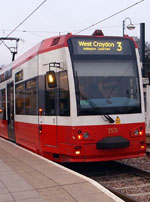
Tram in Croydon, South London: British parliament critisises poor integration of light rail schemes (Photo: David Bosher)

Passenger Transport Executive Group
Wellington House
40-50 Wellington
Leeds LS1 2DE
Internet:
www.pteg.net


FRONT PAGE
SiteSearch
About us
Directories


UK light rail schemes
London Underground
London transport and PPP
Barcelona Metro
New York City Subway
Paris Métro
Sao Paulo Metro
Tokyo Metro
Road traffic kills children
Traffic congestion in the US
London congestion charge


City Mayors reports news from towns and cities around the world. Worldwide | Elections | North America | Latin America | Europe | Asia | Africa | Events |


Mayors from The Americas, Europe. Asia, Australia and Africa are competing for the annual World Mayor Award. More


City Mayors ranks the world’s largest as well as richest cities and urban areas. It also ranks the cities in individual countries, and provides a list of the capital cities of some 200 sovereign countries. More


City Mayors reports political events, analyses the issues and depicts the main players. More


City Mayors describes and explains the structures and workings of local government in Europe, The Americas, Asia, Australia and Africa. More


City Mayors profiles city leaders from around the world and questions them about their achievements, policies and aims. More


City Mayors deals with economic and investment issues affecting towns and cities. More


City Mayors reports on how business developments impact on cities and examines cooperation between cities and the private sector. More


City Mayors describes and explains financial issues affecting local government. More


City Mayors lists and features urban events, conferences and conventions aimed at urban decision makers and those with an interst in cities worldwide. More


City Mayors reports urban environmental developments and examines the challenges faced by cities worldwide. More


City Mayors reports on and discusses urban development issues in developed and developing countries. More


City Mayors reports on developments in urban society and behaviour and reviews relevant research. More


City Mayors deals with urban transport issues in developed and developing countries and features the world’s greatest metro systems. More


City Mayors examines education issues and policies affecting children and adults in urban areas. More


City Mayors investigates health issues affecting urban areas with an emphasis on health in cities in developing countries. More


City Mayors examines the importance of urban tourism to city economies. More


City Mayors examines the contributions history and culture make to urban society and environment. More


City Mayors describes the history, architecture and politics of the greatest city halls in the world. More


City Mayors invites readers to write short stories about people in cities around the world. More


City Mayors questions those who govern the world’s cities and talks to men and women who contribute to urban society and environment. More


City Mayors profiles national and international organisations representing cities as well as those dealing with urban issues. More


City Mayors reports on major national and international sporting events and their impact on cities. More


City Mayors lists cities and city organisations, profiles individual mayors and provides information on hundreds of urban events. More


British parliament criticises government
over approach to light railway schemes

By Andrew Stevens, Deputy Editor

12 April 2005: The excessively complicated design, build, operate and maintain contracts for light rail schemes in England has rendered such schemes unmanageable and of poor value to the public.  This was among several conclusions by the British House of Commons Public Accounts Committee from an inquiry as to why so few schemes have been completed satisfactorily.  "The Department for Transport has persisted in an arm's length approach towards light rail," said committee chairman Edward Leigh (Conservative).

"In general, there has been poor integration with other public transport, poor provision of supporting facilities like park and ride, and poor route planning - with lines often not connecting shopping and business areas with where people live.”, he added.

In its report, issued on 5 April 2005, the committee argued that the government’s use of such contracts had the effect that ‘operators have been left to bear all of the revenue risks, and have built risk premia into their bids’. These included parking provision at stops, traffic prioritisation, planning consent provision along the route, and other factors not under the control of operators.  The report claims that this drove up the costs of the Manchester Metrolink extension, Leeds Supertram and South Hampshire Rapid Transit to the point where the Department for Transport withdrew its funding last year. It said the department had not acted quickly enough to help bidders when these problems became obvious.

The members of parliament (MPs) also criticised the lack of integration of light rail with other forms of transport. Bus operators outside London are not regulated, and so can undercut light rail with cheaper fares.  The report said the DfT should require bids to show plans for transport integration.  Construction costs per kilometre have ranged from £21.2m (US$38.2m) for Manchester Metrolink phase 2 to £5.4m ($9.7m) for the Sunderland extension in Tyne and Wear.  The average cost was £10.2m ($18.4m).

Since 1980 the Department for Transport has contributed £1.2 billion ($2.16bn) to the £2.3 billion ($4.14bn) that has been spent on building seven light rail systems in England.  Despite the cost, there has been only a partial evaluation of what light rail has delivered.

"Systems have improved the quality and choice of public transport, offering fast, frequent and reliable services and providing comfortable and safe journeys" said the report.

"But they have not delivered all of their anticipated benefits.

"Some have fallen well short of their passenger forecasts and have been poorly integrated with other forms of public transport.

"Outside London, for example, light rail and de-regulated bus services have been competing for passengers, rather than providing an integrated service."

There are seven light rail lines in England, which carried 142.9m passengers in 2003/04.  These include the Metrolink in Manchester and the Supertram in Sheffield, the latter being widely held up as badly-planned and under-used by local citizens.  The recent extension of the Tyne and Wear Metro from Newcastle into its neighbouring city of Sunderland was one of the more cost-effective projects.

Following the 1986 abolition of the Metropolitan Counties covering the largest cities of England, Passenger Transport Executives have been responsible for the building and upkeep of light rail systems.  The number of light rail systems in England’s cities is comparatively small compared to continental Europe due to its local government system not allowing cities the ability to borrow or take risks on such schemes.  Furthermore, the dependence on the car economy by central governments from the 1960s onwards saw most English cities’ tram systems torn out of the streets, with only the antiquated electric tram system in Blackpool remaining.


Tram in Lyon, France: European cities are increasingly integrating tram, rail and bus services (Photo: Passenger Transport Executive Group)

RIBA President calls for stronger recognition of New Urbanism
A call from an outspoken leading British architect for urbanism to be recognised as a vocation in itself has shone a spotlight on the movement for New Urbanism. The initiative by George Ferguson, the President of the Royal Institute of British Architects (RIBA), dictates a new approach to the planning of cities and calls for the various professions which play a part in the process of urban renewal – city planners, architects and regeneration consultants – to be bound by new institutions and a collective commitment to the better design of cities. More