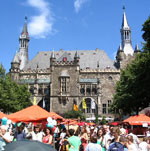
Aachen's city hall dates back to the 14th century (Photo: http://drakin.com)

FRONT PAGE
Site Search
About us

City Halls: Europe
| Aachen | Antwerp | Athens | Berlin | Birmingham | Bolton | Bradford | Bremen | Brighton | Cardiff | Cologne | Cork | Dresden | Florence | Glasgow | Hanover | Innsbruck | Jena | Leeds | Liverpool | London | Manchester | Moscow | Munich | Neuss | Paris | Sheffield | Southampton | Stockholm | Stuttgart | The Hague | Vienna |
City Halls: The Americas
| Bogota | Boston | Buenos Aires | Chicago | Houston | New York | Philadelphia | Pittsburgh | San Francisco | Seattle | Toronto | Vancouver |
City Halls: Asia + Australasia
| Ekaterinburg | Sydney | Tokyo | Wellington |
WORLD MAYOR
PRIZE 2018
Nominate exceptional women mayors for the World Mayor Prize
The 2018 World Mayor Project is dedicated to women in local government. It features the achievements of women mayors from across the world and will honour the best of them.
Please nominate your candidate now
Women have fought prejudice and struggled for equal rights and opportunities for hundreds of years. They did it with courage and resolve. In the 20th and early 21st centuries, women have achieved success in many spheres previously reserved to or monopolised by men, but their contributions are still often undervalued and their potential not recognised enough. Only some 20 per cent of the world’s mayors are women.
The 2018 World Mayor Project aims to encourage more women to consider a career in local government and stand for political office.
Please nominate
exceptional women
mayors for the 2018
World Mayor Prize
and honours.
Aachen City Hall
By Urs Enke
19 February 2006: Rumour has it that some people on their first visit to Aachen mistake the historical City Hall for part of Charlemagne's famous Cathedral. While the former does have a carillon, but hardly looks like a church, the error is probably due to the City Hall’s massive appearance and its situation on higher ground than the neighbouring Cathedral, whose relatively modest size scarcely lives up to its fame.
First built 1330-49 on a Karolingian palace's remnants, only one of the City Hall's lateral towers (Granusturm) dates back to Charlemagne's time. Conceived as a symbol of pride of the citizens of Aachen, which back then had the special status of an 'Imperial Free City' in the Holy Roman Empire, the City Hall started hosting the banquets that followed the crowning of German kings - a title usually preluding emperorship - in the Cathedral nearby.
In 1656, destruction caused by a large fire prompted the rebuilding of some roofs and towers in baroque style of the gothic building. Further changes turned it into a baroque palace in the 18th century, but these were reversed in the 19th alongside the addition of neo-gothic paintings, reliefs and sculptures, among them a an array of 50 statues of German kings on the elaborate north facade. Another fire in 1883 as well as World War II once again destroyed roofs and towers, whose reconstruction was not completed until 1978.
The contemporary appearance of Aachen's City Hall is thus an amalgamation of the works of various eras, with many interesting and playful details incorporated. Historical art can also be found inside, but the Imperial Treasures on display are mere copies of originals now exhibited in Vienna's Imperial Palace.
Today, the building only partly does justice to the term 'City Hall': The city council still convenes there, but the daily administrative work takes place elsewhere. The prestigious rooms, especially the Coronation Hall, find a far more fitting use in the form of various festivities, most notably the annual ceremony during which the city's famous Charlemagne Prize is awarded. The prize honours individuals or organizations, who have made outstanding contributions to the European cause – nowadays by more peaceful means than those employed by Charlemagne himself.
Most citizens of Aachen, however, enjoy their City Hall as a magnificient backdrop for any public events taking place on the market square or on the ‘Katschhof’ square between the City Hall and the Cathedral, especially the traditional Christmas Fair.
Currently, the city administration is planning a modern, glass-faced museum to join the two historical buildings in a surely controversial redevelopment move, yet one fully in line with 1200 years' tradition of architectural change. Citizens and tourists alike have definitely not seen the last of it.