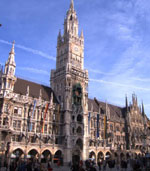
Munich's City Hall. The fist phase of the building, constructed in red bricks, is on the right
Internet:
Muncih City Hall
Munich Tourist Office

FRONT PAGE
Site Search
About us | Quiénes somos |
A propos de nous | Über uns |
Mayor Monitor
Directories
Events
Debate

City Halls: Europe
| Aachen | Antwerp | Athens | Berlin | Birmingham | Bolton | Bradford | Bremen | Brighton | Cardiff | Cologne | Cork | Dresden | Florence | Glasgow | Hanover | Innsbruck | Jena | Leeds | Liverpool | London | Manchester | Moscow | Munich | Neuss | Paris | Sheffield | Southampton | Stockholm | Stuttgart | The Hague | Vienna |
City Halls: The Americas
| Bogota | Boston | Buenos Aires | Chicago | Houston | New York | Philadelphia | Pittsburgh | San Francisco | Seattle | Toronto | Vancouver |
City Halls: Asia + Australasia
| Ekaterinburg | Sydney | Tokyo | Wellington |

City Mayors reports news from towns and cities around the world. Worldwide | Elections | North America | Latin America | Europe | Asia | Africa |

City Mayors ranks the world’s largest, best as well as richest cities and urban areas. It also ranks the cities in individual countries, and provides a list of the capital cities of some 200 sovereign countries. More

City Mayors profiles city leaders from around the world. More

City Mayors describes the history, architecture and politics of the greatest city halls in the world. More

Mayors from The Americas, Europe. Asia, Australia and Africa compete for the World Mayor Award. More

Use Mayor Monitor to rate the performance of mayors from across the world More

In your opinion: Praise Criticise. Write

City Mayors reports political events, analyses the issues and depicts the main players. More

City Mayors describes and explains the structures and workings of local government in Europe, The Americas, Asia, Australia and Africa. More

City Mayors deals with economic and investment issues affecting towns and cities. More

City Mayors describes and explains financial issues affecting local government. More

City Mayors reports urban environmental developments and examines the challenges faced by cities worldwide. More

City Mayors reports on and discusses urban development issues in developed and developing countries. More

City Mayors reports on developments in urban society and behaviour and reviews relevant research. More

City Mayors invites readers to write about the people in their cities. More

City Mayors examines city brands and marketing. More

City Mayors lists and features urban events, conferences and conventions aimed at urban decision makers and those with an interst in cities worldwide. More

City Mayors deals with urban transport issues in developed and developing countries and features the world’s greatest metro systems. More

City Mayors examines education issues and policies affecting children and adults in urban areas. More

City Mayors investigates health issues affecting urban areas with an emphasis on health in cities in developing countries. More

City Mayors reports on how business developments impact on cities and examines cooperation between cities and the private sector. More

City Mayors examines the contributions history and culture make to urban society and environment. More

City Mayors examines the importance of urban tourism to city economies. More

City Mayors questions those who govern the world’s cities and talks to men and women who contribute to urban society and environment. More

City Mayors profiles national and international organisations representing cities as well as those dealing with urban issues. More

City Mayors reports on major national and international sporting events and their impact on cities. More

City Mayors lists cities and city organisations, profiles individual mayors and provides information on hundreds of urban events. More
City Mayors reports news from towns and cities around the world. Worldwide | Elections | North America | Latin America | Europe | Asia | Africa |
City Mayors ranks the world’s largest, best as well as richest cities and urban areas. It also ranks the cities in individual countries, and provides a list of the capital cities of some 200 sovereign countries. More
City Mayors profiles city leaders from around the world. More
City Mayors describes the history, architecture and politics of the greatest city halls in the world. More
Mayors from The Americas, Europe. Asia, Australia and Africa compete for the World Mayor Award. More
Use Mayor Monitor to rate the performance of mayors from across the world More
In your opinion: Praise Criticise. Write
City Mayors reports political events, analyses the issues and depicts the main players. More
City Mayors describes and explains the structures and workings of local government in Europe, The Americas, Asia, Australia and Africa. More
City Mayors deals with economic and investment issues affecting towns and cities. More
City Mayors describes and explains financial issues affecting local government. More
City Mayors reports urban environmental developments and examines the challenges faced by cities worldwide. More
City Mayors reports on and discusses urban development issues in developed and developing countries. More
City Mayors reports on developments in urban society and behaviour and reviews relevant research. More
City Mayors invites readers to write about the people in their cities. More
City Mayors examines city brands and marketing. More
City Mayors lists and features urban events, conferences and conventions aimed at urban decision makers and those with an interst in cities worldwide. More
City Mayors deals with urban transport issues in developed and developing countries and features the world’s greatest metro systems. More
City Mayors examines education issues and policies affecting children and adults in urban areas. More
City Mayors investigates health issues affecting urban areas with an emphasis on health in cities in developing countries. More
City Mayors reports on how business developments impact on cities and examines cooperation between cities and the private sector. More
City Mayors examines the contributions history and culture make to urban society and environment. More
City Mayors examines the importance of urban tourism to city economies. More
City Mayors questions those who govern the world’s cities and talks to men and women who contribute to urban society and environment. More
City Mayors profiles national and international organisations representing cities as well as those dealing with urban issues. More
City Mayors reports on major national and international sporting events and their impact on cities. More
City Mayors lists cities and city organisations, profiles individual mayors and provides information on hundreds of urban events. More
Munich City Hall
By Gregor Gosciniak, German Editor
25 July 2005: Built in the 1860s, the Munich City Hall’s neo-gothic architecture is the result of a show of strength between a local, rather conservative, politician and the City Council. The politician opposed the Council’s plan for a Renaissance-style building to replace the old City Hall (Altes Rathaus). Eventually, Munich’s City Council caved in and asked Georg von Hauberrisser, then a 24-year old architectural student, to design a new City Hall.
Hauberrisser approached the task with the fervor characteristic of a newly employed college graduate. He designed everything himself, including the City Hall’s intricate façade, the labyrinth pattern on the floor of the main inner courtyard, the furniture and even the lighting fixtures.
In 1874, when the new building was ready to be opened, everyone realised there was one major problem: it was too small!
While the City of Munich hastily arranged the purchase of additional land, von Hauberrisser went back to the drawing board. It was during the second phase of design and construction that the City Hall’s famous clock with its Glockenspiel was added.
The extension to the City Hall was completed in 1904. Today, it is very noticeable where the first construction phase ended and the second began. Red bricks of the earlier half meet with pale stone used in the building of the extension. In an effort to give the City Hall a more unified appearance, statues of the Wittelsbach royal family were added.
Fortunately, during the Second World War the building suffered little damage. The magnificent stained glass windows, the twisting staircases, the vaulted ceilings and the elaborately caved woodwork are, for the most part, in their original state.
On a clear day, visitors to Munich’s City Hall can enjoy far-reaching views of the city and the Alps from its 85-metre high tower.
Every day at 11am, noon and at 5pm the almost life-size figures of the Glockenspiel re-enact two events of Munich’s history: a tournament held in 1568 to celebrate a royal marriage and Schäfflertanz (Cooper’s Dance), which dates back to the 17th century then celebrating the passing of the plague.
At 9pm, a short performance features the Münchner Kindl, the little monk, who is the city’s symbol, being led to bed by the night watchman of Munich and the Friedensengel (Angel of Peace). The 43 bells of the clock, weighing about 7,000 kilos) play a lullaby, while the clock is specially lit during the duration of the performance.