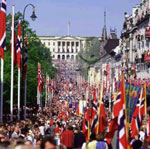
Oslo is the most expensive city in the world...

FRONT PAGE
Site Search
About us | Quiénes somos |
A propos de nous | Über uns |
Mayor Monitor
Directories
Events
Debate

UBS: Most expensive and richest cities
ECA: Most expensive cities
EIU: Most expensive cities
Mercer: Most expensive cities
Most powerful cities
World's richest cities (GDP)
Richest cities (earnings)
World's best financial cities
Europe's top city brands
European growth cities 2009
Real estate USA
Real estate Europe
European business cities
Best world cities to live in
Global cities
World's largest cities
and their mayors 2010

City Mayors reports news from towns and cities around the world. Worldwide | Elections | North America | Latin America | Europe | Asia | Africa | Events |

Mayors from The Americas, Europe. Asia, Australia and Africa are competing for the annual World Mayor Award. More

City Mayors ranks the world’s largest as well as richest cities and urban areas. It also ranks the cities in individual countries, and provides a list of the capital cities of some 200 sovereign countries. More

City Mayors reports political events, analyses the issues and depicts the main players. More

City Mayors describes and explains the structures and workings of local government in Europe, The Americas, Asia, Australia and Africa. More

City Mayors profiles city leaders from around the world and questions them about their achievements, policies and aims. More

City Mayors deals with economic and investment issues affecting towns and cities. More

City Mayors reports on how business developments impact on cities and examines cooperation between cities and the private sector. More

City Mayors describes and explains financial issues affecting local government. More

City Mayors lists and features urban events, conferences and conventions aimed at urban decision makers and those with an interst in cities worldwide. More

City Mayors reports urban environmental developments and examines the challenges faced by cities worldwide. More

City Mayors reports on and discusses urban development issues in developed and developing countries. More

City Mayors reports on developments in urban society and behaviour and reviews relevant research. More

City Mayors deals with urban transport issues in developed and developing countries and features the world’s greatest metro systems. More

City Mayors examines education issues and policies affecting children and adults in urban areas. More

City Mayors investigates health issues affecting urban areas with an emphasis on health in cities in developing countries. More

City Mayors examines the importance of urban tourism to city economies. More

City Mayors examines the contributions history and culture make to urban society and environment. More

City Mayors describes the history, architecture and politics of the greatest city halls in the world. More

City Mayors invites readers to write short stories about people in cities around the world. More

City Mayors questions those who govern the world’s cities and talks to men and women who contribute to urban society and environment. More

City Mayors profiles national and international organisations representing cities as well as those dealing with urban issues. More

City Mayors reports on major national and international sporting events and their impact on cities. More

City Mayors lists cities and city organisations, profiles individual mayors and provides information on hundreds of urban events. More
|
|
The most expensive and
richest cities in the world
A report by UBS
22 August 2009: Oslo, Zurich, Copenhagen, Geneva, Tokyo and New York have emerged as the world's most expensive cities based on a standardised basket of 122 goods and services. When rent prices are factored into the equation, New York, Oslo, Geneva and Tokyo emerge as especially expensive places to live. The basket costs the least in Kuala Lumpur, Manila, Delhi and Mumbai. The newly introduced iPod index measure how long an employee would have to work to be able to afford the Apple MP3 player. The study Prices and Earnings by Swiss bank UBS is based on data collected in 73 cities around the world between March and April 2009.
| Prices | Earnings | iPod index | Working hours | The Americas | Asia-Pacific | Europe | Switzerland |
Prices
Many of the world’s regions have switched places in the UBS rankings as currencies fluctuated in the wake of the financial crisis. London, the second most expensive city in the 2006 review, plummeted nearly 20 places following the pound’s steep devaluation, landing in the middle of the Western European rankings. Currency devaluation pushed down prices in many emerging market cities as well. Prices slipped the most in Mexico City, Moscow and Seoul. Despite the overall slump in average prices in Latin America, Caracas proved to be a costly place to visit. One likely reason for the massive price increases in Venezuela’s capital is its high inflation rate of 30 per cent over the past three years, which a reduction in the official exchange rate, pegged to the US$ since March 2005, could not fully offset. Ranking & table
US$ 2,670: that is what the UBS basket of 122 goods and services costs in an average Western European metropolis. This is 40 per cent more expensive than in the Eastern European and South American cities. The gap with North America was much smaller. The basket costs an average of US$ 2,590 in the US and US$ 2300 in Canada. The UBS survey indicated that the price differential between the cheapest and costliest region or city tends to vary from product group to product group. Labour-intensive service in Western Europe and North America, for example, are relatively expensive compared with other regions in the world due to high labour costs. In emerging markets, by contrast, electronics and household appliances were pricey in relation to the over -all local price level.
Earnings
The UBS survey of 73 international cities found that employees in Copenhagen, Zurich, Geneva and New York had the highest gross earnings. The undisputed champion in our international wage comparison is Zurich. Net incomes are higher there than in any other city in the world. With its extremely high gross wages and comparatively low tax rates, Switzerland is a very employee-friendly country. No other city in the comparison allowed workers to take home more income at the end of the month than Zurich and Geneva. A continental comparison of average incomes paints a different picture: on average, the world’s highest gross and net wages are paid in North America. However, there is a wage differential in North America as well. Wages in New York, Los Angeles, Miami and Chicago are significantly higher on average than in the Canadian metropolises of Montreal and Toronto. Ranking & table
The disparities are even starker in Europe. On average, workers in Western European cities receive more than three times the pay of their colleagues in Eastern Europe. The lowest incomes are paid in Sofia, Bulgaria, and Bucharest, Romania. The wage level in these two countries, which joined the European Union in January 2007, is comparable with that of Colombia and Thailand. South American and African cities are the only ones with lower average wages than those of Eastern Europe. This makes it easy to understand the two-way economic traffic of globalization: jobs go east while workers emigrate to the West. The city ranking has changed little since the 2003 survey, with the notable exception of London’s currency-driven demotion. The lowest average wages are still found in the Indian cities of Delhi and Mumbai, and in Jakarta, Indonesia, and Manila, the Philippines. Ranking & table
The iPod index
One vivid way to illustrate the relative purchasing power of wages is to replace the abstract basket of goods and services with a specific, highly uniform product that is available everywhere with the same quality, and then calculate how long an employee would have to work to be able to afford it in each city. The study determined that employees have to work a global average of 37 minutes to earn enough to pay for a Big Mac, 22 minutes for a kilo of rice and 25 minutes for a kilo of bread. For the first time, a non-food product was used in the study to compare working hours.
The iPod nano with 8 GB of storage is an ideal example of a globally uniform product. An average wage-earner in Zurich and New York can buy a nano from an Apple store after nine hours of work. At the other end of the spectrum, workers in Mumbai, need to work 20 nine-hour days roughly the equivalent of one month's salary to purchase an iPod nano. Ranking & table
Working hours
Long working hours in the Middle East and Asia shortest in France
People work an average of 1,902 hours per year in the surveyed cities but they work much longer in Asian and Middle Eastern cities, averaging 2,119 and 2,063 hours per year respectively. Overall, the most hours are worked in Cairo (2,373 hours per year), followed by Seoul (2,312 hours). People in Lyon and Paris, by contrast, spend the least amount of time at work according to the global comparison: 1,582 and 1,594 hours per year respectively.
The Americas
A dollar earned in the US is worth more after deducting taxes and social security contributions than in neighboring Canada. While the basket of 122 goods and services is somewhat cheaper in Montreal and Toronto, the net hourly wage in these Canadian cities is also lower than in the surveyed US cities of New York, Los Angeles, Miami and Chicago.
Asia-Pacific
In no other continent is the price spread between the most expensive and the cheapest city as wide as in Asia. While Tokyo ranks as one of the world's five costliest cities, Kuala Lumpur, Manila, Delhi and Mumbai are all at the bottom of the price range. Workers in Tokyo earn the highest wages in Asia. Likewise, consumers in Tokyo, Hong Kong and Taipei have the greatest purchasing power in the continent. Sydney ranks among the top ten cities in the international comparison.
Europe
Prices in Eastern and Western Europe have converged very little despite the EU's enlargement in 2004 and Slovenia's adoption of the euro as its official currency in January 2007 and Slovakia's in January of this year. A basket of 95 goods and 27 services was roughly 35 per cent cheaper in the cities of Eastern European EU member states than in Western European metropolises. As a comparison, UBS's 2006 study found that the price differential between Eastern and Western Europe was around 38 per cent. On average, workers in Western European cities receive gross wages more than three times higher than their colleagues in Eastern Europe. The lowest incomes are paid in Bulgaria (Sofia) and Romania (Bucharest). The wage level in these two countries, which joined the European Union in January 2007, is comparable to that of Colombia or Thailand.
London, the second most expensive city in the 2006 review, plummeted nearly twenty places following the pound's precipitous devaluation in March and April 2009 when the data was collected, landing in the middle in terms of Western European countries. During this time the GBP reached a low point of roughly 1.40 against the USD from which it recently appreciated to around 1.70. This rebound in the GBP exchange rate increased London's price level by 21 per cent in USD terms, which would lift London from twenty-first to fifth in our global price ranking.
Rail travel is most expensive in the United Kingdom and Germany. A second-class, one-way ticket for a 200 km rail journey in Germany (average price: EUR 51.40 or US$ 67.20) costs approximately 1.5 times as much as in the rest of Western Europe. Only the United Kingdom is more expensive. In London, passengers have to be willing to pay EUR 68.20 (US$ 89.10) double the fare charged in other Western European cities.
Switzerland
Residents of Geneva and Zurich in Switzerland pay around 20 per cent more on average for products, services and accommodation than people in other Western European cities. With its extremely high gross wages and comparatively low tax rates, Switzerland is a very employee-friendly country. No other city allows workers to take home more income at the end of the month than Zurich and Geneva. Average gross hourly wages (before taxes and social security contributions) can purchase the most in Copenhagen, Zurich and Geneva. Bringing up the tail are Jakarta, Manila, Mumbai and Nairobi, where average gross hourly wages have between 11 per cent and 15 per cent of the purchasing power of a salary in Zurich. The basket of 39 food products is the priciest in Tokyo. Food prices are only marginally lower in Switzerland: Zurich occupies second place, Geneva third. Food prices in Switzerland are around 45 per cent more expensive than the average in the rest of Western Europe.
UBS survey: Introduction | The most expensive cities | The richest cities (personal earnings) | Richest cities (purchasing power) | The iPod index |
Methodology
USB conducted its standardized Prices and Earnings survey in 73 international cities in March 2009. The data was collected by several independent observers in each city. In all, more than 30,000 data points were included in the analysis. All amounts were converted into a single currency to ensure that the surveyed prices and earnings could be compared. To compensate for daily exchange rate fluctuations, we used the average exchange rate over the data collection period. An international price comparison needs a common, standard basket of goods and services. As in past studies, the basket of goods and services was based on Western European consumer preferences. Living costs were calculated based on a survey of 154 items in total. They include 122 products and services that are used directly to calculate the reference basket. Apartment rents were classified as high-, mid- and low-priced.
|
|

The average employee has to work nine hours to afford an iPod nano, whereas in Mumbai he has to work 177 hours
Related research
THE MOST EXPENSIVE CITIES IN THE WORLD
UBS survey (August 2009): Most expensive cities (Intro) | World's most expensive cities (table) | Richest cities by personal earnings (table) | Richest cities by purchasing power (table | iPod index |
ECA International survey (June 2009): Introduction | Table: World | Table: Europe | Table: Asia |
Mercer survey (2009): Most expensive cities
EIU survey (2009): Most expensive cities
RICHEST CITIES BY GDP
Introduction | 150 richest cities in 2005 | 150 richest cities in 2020 | Europe's richest cities |
THE LARGEST CITIES IN THE WORLD AND THEIR MAYORS 2010
Introduction
Cities by size: 1 to 150 | 151 to 300 | 301 to 450 | 451 to 550 |
Cities in alphabetical order: A to D | E to L | M to R | S to Z |
Cities by countries: A to D | E to L | M to R | S to Z |
|