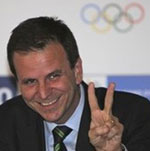
Eduardo Paes, Mayor of Rio de Janeiro, after the city's win of the 2016 Olympics

FRONT PAGE
About us
 

MAYORS OF THE MONTH
In 2015
Mayor of Seoul, South Korea (04/2015)
Mayor of Rotterdam, Netherlands (03/2015)
Mayor of Houston, USA, (02/2015)
Mayor of Pristina, Kosovo (01/2015)
In 2014
Mayor of Warsaw, Poland, (12/2014)
Governor of Tokyo, Japan, (11/2014)
Mayor of Wellington, New Zealand (10/2014)
Mayor of Sucre, Miranda, Venezuela (09/2014)
Mayor of Vienna, Austria (08/2014)
Mayor of Lampedusa (07/2014)
Mayor of Ghent, Belgium (06/2014)
Mayor of Montería, Colombia (05/2014)
Mayor of Liverpool, UK (04/2014)
Mayor of Pittsford Village, NY, USA (03/2014)
Mayor of Surabaya, Indonesia (02/2014)
Mayor of Santiago, Chile (01/2014)
In 2013
Mayor of Soda, India (12/2013)
Mayor of Zaragoza, Spain (11/2013)
Mayor of Marseille, France (10/2013)
Mayor of Schwäbisch Gmünd, Germany (09/2013)
Mayor of Detroit, USA (08/2013)
Mayor of Moore, USA (07/2013)
Mayor of Mexico City, Mexico (06/2013)
Mayor of Cape Town, South Africa (05/2013)
Mayor of Lima, Peru (04/2013)
Mayor of Salerno, Italy (03/2013)
Governor of Jakarta, Indonesia (02/2013)
Mayor of Rio de Janeiro, Brazil (01/2013)
In 2012
Mayor of Izmir, Turkey (12/2012)
Mayor of San Antonio, USA (11/2012)
Mayor of Thessaloniki, Greece (10/2012)
Mayor of London, UK (09/2012)
Mayor of New York, USA (08/2012)
Mayor of Bilbao, Spain (07/2012)
Mayor of Bogotá, Columbia (06/2012)
Mayor of Perth, Australia (05/2012)
Mayor of Mazatlán, Mexico (04/2012)
Mayor of Tel Aviv, Israel (03/2012)
Mayor of Surrey, Canada (02/2012)
Mayor of Osaka, Japan (01/2012)
In 2011
Mayor of Ljubljana, Slovenia (12/2011)

Worldwide | Elections | North America | Latin America | Europe | Asia | Africa |


 




 













|
|
Mayor of the Month for January 2013*
Eduardo Paes
Mayor of Rio de Janeiro
By Andrew Stevens
4 June 2013*: As with his predecessor Cesar Maia, Eduardo Paes' journey to the Rio de Janeiro mayoralty was one of constant political shapeshifting. Yet in 2009 the mayor's prominence, just eight months into office, shot up on a global scale thanks to the city's successful bid for 2016 Olympic Games. Rio's daily battle against gang violence, thanks to the juxtaposition of extreme poverty in the favelas and the beachfront high life, was most recently documented in the hit Elite Squad films. Paes, however, wants the city to be known for successful staging back to back the world's two greatest sporting events and for becoming a leading smart city. Mayor Paes was shortlisted for the 2012 World Mayor Prize.
To understand Eduardo Paes’ political journey before taking office this year, we do not have to imagine Elite Squad but perhaps one of the country’s infamously convoluted telenovelas (soap operas). Paes’ mandate follows that of three-term mayor César Maia (1992-1996, 2000-2008), who attracted as much attention for his party-hopping (from Communist (PCB) to Democratic Labour (PDT), then to the Brazilian Democratic Movement Party (PMDB) and finally to Liberal Front (PFL) as his right-wing social policies. A law graduate, Paes first entered political life as the sub-prefect (Brazilian mayors are known as prefects) for the Barra de Tijuca district of Rio, appointed by the first Maia administration. At that time he was associated with the Green Party (PV) but switched allegiance to the right-leaning PFL (now Democrats) upon his election to the city council in 1996, where he remained only a short while before securing election as a deputy to Congress in 1998, though this time for the centre-right Brazilian Labour Party (PTB). On Maia’s return to the mayoralty in 2000, Paes was appointed municipal secretary for environmental management and migrated back to the PFL a year later. Bizarrely he then elected to defect to the centrist technocrat Brazilian Social Democratic Party (PSDB) only a year after his re-election to Congress in 2002.
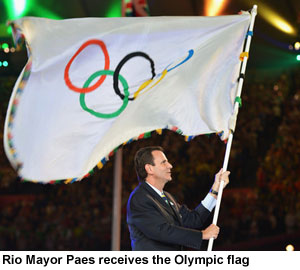 During his time in Congress in Brasília, Paes was a noted trenchant critic of the Lula administration, particularly during the Mensalão scandal in 2005 over alleged payments to congressmen for votes. The scandal rocked the Lula administration, not only because of alleged payments to opposition congressmen for votes to shore up his majority in congress, but also the revelations concerning his Workers’ Party (PT), particularly finance minister Antonio Palocci’s tenure as mayor of the city of Ribeirão Preto in São Paulo and the unsolved case of assassinated mayor Celso Daniel of Santo André, São Paulo. During his time in Congress in Brasília, Paes was a noted trenchant critic of the Lula administration, particularly during the Mensalão scandal in 2005 over alleged payments to congressmen for votes. The scandal rocked the Lula administration, not only because of alleged payments to opposition congressmen for votes to shore up his majority in congress, but also the revelations concerning his Workers’ Party (PT), particularly finance minister Antonio Palocci’s tenure as mayor of the city of Ribeirão Preto in São Paulo and the unsolved case of assassinated mayor Celso Daniel of Santo André, São Paulo.
In the 2006 gubernatorial elections for Rio state, Paes supported the PMDB’s Sergio Cabral Jr (who backed Lula for re-election that year) against Maia’s choice of Denise Frossard of the PFL-supported Unite for Change left-green ticket (which also backed the Alckmin presidential ticket of Paes’ own PSDB). Paes was appointed as state secretary for sports and tourism in the Cabral government. He then defected once again, to the centrist PMDB, before emerging as Cabral’s choice to replace the term-limited Maia at the 2008 elections. Paes faced some opposition to gain the PMDB ticket for the mayoral race from Marcelo Itagiba, the state secretary for security in the government of populist evangelical Rosinha Garotinho (2003-2007, wife of former governor Garotinho, who preceded her).
Having picked up the PMDB nomination and made his peace with Lula, whose PT has scant presence in the city’s politics, Paes faced off against Green Party founder and former anti-dictatorship MR-8 guerrilla Fernando Gabeira. During the autumn 2008 campaign itself, Paes made considerable mention of his former party colleague’s past revolutionary activities, including his role in the infamous 1969 kidnap of the US ambassador, but only managed to defeat him by the narrowest of margins in the second round, 50.8 per cent to 49.1 per cent, despite Lula’s support and a high-spending campaign. In addition to Paes’ charges against Gabeiro’s past, Paes himself had to contend with a number of unattributed slurs on his character and eligibility to stand (the latter owing to a technicality arising from his state office and the nomination period). Throughout the first round, Paes was also dogged by accusations of hypocrisy levelled by Communist (PC do B) congresswoman Jandira Feghali, who repeatedly drew attention to his previous attacks on Lula, despite now parading the president’s support. She herself then performed her own volte-face by allying herself to Paes in the second round, being rewarded with the post of municipal secretary of culture in his administration.
One considerable inheritance from the Maia era is the city’s double hosting of the 2014 World Cup and the 2016 Olympic Games, having successfully hosted the 2007 Pan-American Games after the disappointment of losing out on staging the 2012 Olympics. Moments after the success of the Pelé-fronted 2016 bid was announced by the International Olympic Committee gathered in Copenhagen, Paes logged onto his Twitter account to declare “Our city deserves this present,” City-wide jubilation followed as many felt it marked the country’s emergence as a leading global player rather than a third world nation plagued by crime. The city’s honour certainly capped off a remarkable presidency by the charismatic Lula , prevented from running for an assured third term by the country’s constitution. The only sour note to the proceedings was the reporting from some poorer sections of the city who believed the games would only benefit its middle classes. Yet a study by the Fundação Instituto de Administração believes the games will bring $27.5bn extra investment to the city, on top of returning investor confidence which has promoted a small revival in its fortunes in recent years.
Aside from the usual security concerns in the city and possibly as befits a former state culture secretary, tensions have also arisen between various neighbourhoods of the city however owing to the hosting of its globally-admired annual Carnival, with the Paes administration attempting to introduce stricter regulation of routes and registration of participants, a move unthinkable to many who support the carnival’s spontaneous character and allege Paes is governing solely in the interests of the middle classes. For his part, Paes claims the move will lead to a more enjoyable and responsible atmosphere, with better traffic management and toilet provision. Paes has also not shied away from taking on the adult entertainment industry in a city famed for its sex tourism, with local police heavily cracking down severely on phone box flyer-stickers for brothels for "destruction of public property", despite prostitution being legal. "There will be criticisms," Paes recently told The Economist, "but the city’s image is being transformed."
It is in the smart cities arena however, where Paes claims to have made the most impact, appearing at global events (including TED) to showcase Rio’s integrated Operations Centre. Built in partnership with IBM, the Rio Operations Centre opened in 2010 and not only enables the city government to coordinate emergency response and traffic management, but acts as a platform for collaboration between city workers, utility companies and transit authorities. “In Rio de Janeiro, we are applying technology to benefit the population and effectively transitioning to a smarter city,” Paes says, “In addition to using all information available for municipal management, we share that data with the population on mobile devices and social networks, so as to empower them with initiatives that can contribute to an improved flow of city operations.”
In the October 2012 municipal elections, Paes was comfortably re-elected in the first round, defeating his nearest rival Marcelo Freixo of the left-wing P-SOL (Socialism and Freedom Party) 64 per cent to 28 per cent, after which he promised to "work hard and treat the citizens with a lot of respect". Paes was one of the first to acknowledge the contribution of Brazilian architect Oscar Niemeyer and his alignment of social values alongside his modernist creations, by declaring three days of official mourning on his death aged 104 in December 2012. Since the mayor's re-election however, doubts have surfaced in some quarters over the social impact of Paes' games-led infrastructure projects, most notably in favelas which will be razed to make way for Olympics facilities. These local tensions continue to spill over, for instance the mayor's somewhat un-civic conduct in May 2013, when he allegedly assaulted a vocal critic harassing him and his wife in a city restaurant. Then, of course, the protests and disorder which followed throughout the so-called 'Brazil Spring' of anti-poverty and corruption unrest during the summer. Paes will be term-limited out of office after the games are staged in 2016, but it will be some years before it is known whether or not his policies merely appealed to the kind of foreign urbanists who catch TED Talks, while leading to increased social segregation, as his domestic critics argue.
*Updated in June 2013.
|
|
|
